


Neurodivergence and Building a Sustainable Music Career with Nat Bartsch
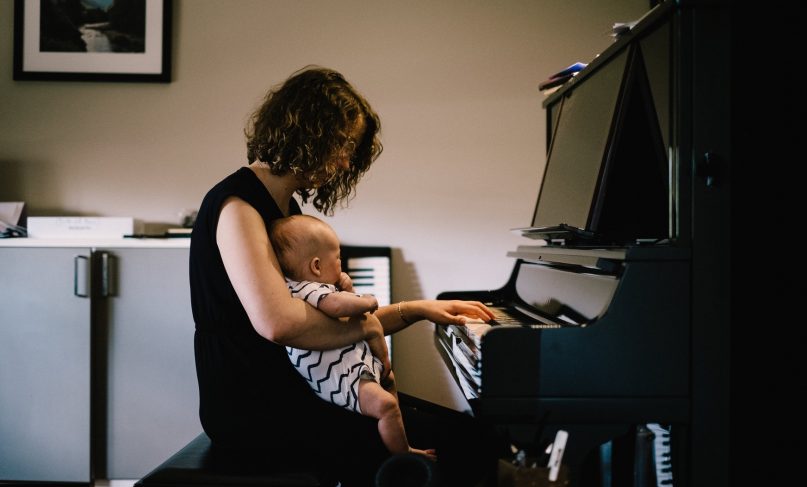
Composer and pianist Nat Bartsch on designing an artistic practice around the way you actually work
The music industry can be a curious place for a neurodivergent artist. Some of the qualities that support an intensely creative life can sit uneasily alongside the practical demands of sustaining a career: touring, networking, administration, funding applications, unfamiliar venues, constant communication and the expectation that artists will simply keep going.
Australian pianist, composer and producer Nat Bartsch explored this tension in an IMC Cooler Clinic on neurodivergence and sustainable artistic practice, drawing on her own experience as a late-diagnosed autistic and ADHD musician.
Bartsch has built a career spanning jazz, classical, ambient and improvised music, alongside running her own label, Amica Records. Her work has increasingly incorporated advocacy around neurodivergence and accessibility. In 2024, she delivered the Australian Music Centre's Peggy Glanville-Hicks Address on late-diagnosed neurodivergence and music.
Her Cooler Clinic offered less a blueprint for what a neurodivergent musician should do than an invitation to ask a different question:
“What if a sustainable career isn't about becoming better at tolerating an unsuitable way of working, but about creating conditions in which you can keep making your best work? ”
The same trait can be an advantage and a difficulty
One of Bartsch's central observations is that it can be misleading to divide neurodivergent traits neatly into strengths and weaknesses.
In her own practice, she identifies qualities including intense interest in music, attention to detail, empathy, authenticity, innovative thinking and an entrepreneurial streak. These can translate into considerable professional strengths: generating work quickly, identifying errors, developing distinctive projects, communicating ideas, building an audience and finding unconventional solutions to problems.
But the same brain also has to run the career surrounding the music.
Bartsch describes difficulties with time blindness, organisation, overcommitment, social anxiety, sensory sensitivities, emotional regulation and losing perspective on a project. An ability to work intensely can become overwork. Attention to detail can become endless revision. An unconventional artistic identity can make it difficult to fit neatly into established genres or professional networks.
The point isn't that these characteristics apply to every autistic or ADHD musician. Bartsch is describing her own neurodivergent profile and what she has learned from it.
Her broader proposition, however, is useful: rather than asking whether a characteristic is inherently a strength or a deficit, it may be more useful to ask:
“Under what conditions does this characteristic help me — and under what conditions does it make my work harder? ”
The artist and the career require different skills
There is another distinction running through Bartsch's thinking: making music and maintaining a music career are not the same job.
A musician may be exceptionally capable in the rehearsal room or on stage while struggling with invoices, emails, scheduling, grant applications, travel arrangements or switching rapidly between unrelated tasks.
For independent artists in particular, the list can become enormous. Composer. Performer. Producer. Project manager. Publicist. Social-media manager. Booker. Fundraiser. Administrator. Accountant. Merch seller.
Bartsch argues that the independence many artists value can therefore have a hidden cost: retaining control often means retaining the work.
And signing with a manager, agent or label doesn't necessarily make that work disappear. Artists still need to understand their career, advocate for themselves and recognise what a potential collaborator can realistically provide.
This is especially relevant in jazz and improvised music, where small teams, self-produced projects and portfolio careers are common.
Designing a career around your capacity
Bartsch proposes five interconnected principles for thinking about a sustainable neurodivergent artistic practice:
- Autonomy.
- Authenticity.
- Flexibility and scalability.
- Support and wellbeing.
- Safety, kindness and community.
Autonomy might mean retaining control over how or when work is released. Authenticity might mean making work that doesn't fit neatly into a genre or conventional career trajectory. Flexibility means designing projects that can expand or contract according to resources and capacity. Support might involve an assistant, access worker, quiet workspace or practical systems. Safety and community mean choosing collaborators and working environments in which the artist doesn't have to expend enormous energy masking or managing interpersonal uncertainty.
The goal isn't to eliminate ambition.
It is to create an infrastructure capable of supporting the ambition.
Make projects scalable
One of Bartsch's most practically useful suggestions is to design projects that can exist at several scales.
She uses her own music as an example. A work might exist as a solo piano performance, a small ensemble project, a larger chamber arrangement or an orchestral version. Parts can sometimes be adapted for different musicians or locations. Recorded and live versions can have different production requirements. Written music can create another life for the material.
That means a project doesn't necessarily collapse because a grant application is unsuccessful, somebody becomes unavailable, health or energy changes, or a presenter has a smaller budget than anticipated.
For an improvising musician, the same principle could mean asking:
“Could this project work as a solo set as well as a quartet? Could local collaborators replace touring personnel? Could the music become a workshop, score, recording, installation or educational project? Is there a €500 version of the idea as well as a €5,000 version? ”
Scalability isn't necessarily about making the artistic idea smaller. It is about separating the core of the idea from one particular method of delivering it.
Know what actually sustains you
Bartsch also encourages artists to know their limitations rather than constructing careers around repeatedly exceeding them.
That might mean designing work that can progress in short bursts, building longer recovery periods into schedules, working primarily with trusted collaborators, or avoiding unnecessary travel and overstimulation.
It can also mean diversifying income and artistic outputs so that everything isn't dependent upon one physically or psychologically demanding activity.
This isn't simply a neurodivergence issue. It is a useful sustainability question for almost any independent musician:
“Could your artistic practice continue through a period of poor health, unsuccessful funding, caring responsibilities or other paid work? ”
A resilient career contains more than one route forward.
Support needs are part of the working method
Bartsch is particularly interested in moving support away from the idea of emergency intervention.
Support can be ordinary infrastructure.
In daily life, she gives examples including sensory tools, visual timers and reminders, planning systems, virtual assistants and support workers. Within music-making, support might include access to a quiet space, help navigating transitions during recording or composing, a tour manager or support worker, or advance information about an unfamiliar venue.
There can also be a forgotten period after the work.
A gig may finish at 10pm, but the neurological demand of the gig doesn't necessarily finish at 10pm. Bartsch suggests thinking explicitly about post-performance needs: decompression time, administrative help, stocktaking and invoicing support, or simply not scheduling something demanding immediately afterwards.
Rather than asking only, Can I physically do this gig?, an artist might ask:
“What will doing this gig cost me before, during and afterwards? ”
The access rider
One practical tool Bartsch strongly advocates is an access rider.
Musicians are already accustomed to technical and hospitality riders. An access rider applies a similar principle to the conditions a person needs in order to work.
It might include requests around communication, lighting, sound, scheduling, breaks, food, travel, dressing-room arrangements, physical accessibility, sensory environment or the way last-minute changes are communicated.
Bartsch suggests normalising these documents rather than forcing artists to repeatedly negotiate or justify their needs.
Importantly, an access rider does not need to become a detailed disclosure of somebody's medical history. Shape Arts describes an access rider as a document communicating disability access needs to collaborators or organisations, and recommends focusing on the practical support required. It can be detailed or streamlined according to the artist's preference.
For example:
- Communication: Please send schedules and significant changes in writing where possible.
- Venue: I need access to a quiet space before the performance.
- Scheduling: Please avoid unnecessary last-minute call-time changes.
- Sensory: I may use earplugs or other sensory aids backstage.
- Recovery: Where possible, please don't schedule interviews or meetings immediately after my performance.
These are examples, not a template for every neurodivergent musician. An access rider should describe the barriers and requirements of the individual artist.
Venues and organisations have a role too
Bartsch's argument doesn't stop at what musicians can do differently.
If an industry is structurally difficult for neurodivergent people to navigate, teaching individual artists to become better at navigating it only solves part of the problem.
In her Peggy Glanville-Hicks Address, Bartsch proposed practical changes organisations could make: more flexible project timelines, clearer advance information, flexible call times, quiet backstage spaces, normalising sensory aids and access riders, and providing visual information or "social stories" showing artists what an unfamiliar venue and backstage environment will be like.
She also argues for mentorship and pathways for neurodivergent artists, greater inclusion of disabled artists and workers, and a change in the culture surrounding distress and overwhelm.
This last point matters.
The mythology of music has often romanticised instability: the tortured genius, the chaotic artist, the difficult personality, the show-must-go-on mentality.
Bartsch asks the industry to become more curious about what sits underneath behaviour. Somebody needing to leave a crowded room, requesting a predictable schedule or becoming overwhelmed by a chaotic working environment isn't necessarily being difficult or unprofessional.
Sometimes the environment is creating the difficulty.
Make the unfamiliar more predictable
One particularly simple suggestion from Bartsch is for venues to provide advance visual information.
For some neurodivergent people, arriving somewhere unfamiliar involves processing a remarkable number of unknowns simultaneously: Where is the entrance? Who am I meeting? What does backstage look like? Where can I sit? Where are the toilets? Where will my instrument go? What happens after soundcheck?
Bartsch suggests that venues can reduce that cognitive load with a simple document containing photographs and practical information.
This doesn't require sophisticated accessibility infrastructure. A venue could provide a short PDF showing the entrance, performance space, dressing room, toilets and key staff contact, alongside a basic timeline for the day.
Bartsch has described these kinds of measures as helping her remain regulated and perform at her best.
And much like ramps, captions or clear signage, measures designed around particular access requirements can often make an environment easier for many other people too.
Artistic integrity doesn't mean ignoring the career
Bartsch also challenges another familiar opposition: artistic integrity versus career strategy.
For her, the music itself can remain completely faithful to the artist's values.
The strategic work happens around it.
Making extraordinary music does not automatically mean people will encounter or understand it. Artists also need time to articulate what they are doing, build relationships with people and organisations, understand the business around their work and create routes through which audiences can find it.
Marketing doesn't have to determine the art.
But refusing to communicate the art doesn't necessarily protect it either.
Bartsch's own career illustrates this approach. Her work sits deliberately between categories including jazz, classical, neoclassical, improvisation and ambient music, while her label Amica Records describes itself as a home for "genre-bending, kind music."
Rather than squeezing the work into a pre-existing niche, her suggestion is essentially to carve one.
Make the music you genuinely want to make. Work with people you trust and admire. Find ways of making it sustainably. Learn how to communicate what connects the work.
Over time, that combination becomes the artistic identity.
A different definition of professionalism
Perhaps the most useful shift in Bartsch's Cooler Clinic is a rethinking of what a successful professional musician looks like.
Professionalism doesn't have to mean tolerating every environment, answering everything immediately, working at maximum capacity, hiding disability, masking discomfort or accepting exhaustion as the price of having a career.
It can also mean understanding the conditions under which you work well — and becoming increasingly skilled at creating them.
For neurodivergent musicians, that may involve an unusual combination of significant capability and significant support needs. Those things aren't contradictory.
As Bartsch puts it in her own framework, the aim is to create the conditions in which the artist's abilities can thrive because their support needs are being met, rather than despite having them.
For musicians considering their own practice, her Cooler Clinic leaves some useful questions:
- Which parts of my musical practice give me energy, and which parts of the career surrounding it consume it?
- Which characteristics become strengths in the right environment and difficulties in the wrong one?
- What am I repeatedly forcing myself to tolerate because I think "professional musicians should be able to do this"?
- What support would make the biggest practical difference?
- Could my next project exist at more than one scale?
- What would I put on an access rider?
- And, most importantly: am I building a career I can actually continue living inside?
The aim isn't to construct the perfect career, or to remove every difficulty from artistic life.
It is to build a practice that has enough flexibility, support and humanity around it that the music can continue.