

Byrd at The Riverside: Patrick stefan reflects on his Navigator Residency
- Process & creation
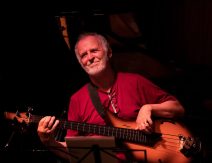
I recently completed my Navigator residency at Riverbank Arts Centre, a space I performed in during the 2023 Kildare Jazz Festival, leading my band and singing my songs.
Coming back to explore a new idea — instrumental ambient birdsong — felt comfortable and welcoming. Starting out, the concept was to improvise live, with a long-time collaborator, to a very slowed-down recording of a migratory bird captured by ornithologist Seán Ronayne. A two-minute recording stretched 23 times and pitched down turns short tweets and trills into long, held ambient notes. These became tones I could hear, respond to, and harmonise with on guitar, adding small loops and drones through my pedals. It sounded like nothing I’d heard before: a bit bizarre but very cool.
The plan changed when my collaborator became unavailable, so I began thinking of other ways to develop the idea. I found myself thinking about migration more broadly — how this particular bird, the Blackcap, moves between West Africa and Ireland, and how my time in Mali learning guitar styles changed how I felt about music and the world.
I had the idea of adding short audio clips of archive voices talking about place, movement and memory, bringing the worlds of birds and people together through the theme of migration. Serendipitously, local artist Fiyin Oluokun was preparing their debut exhibition in Riverbank at the same time, exploring something similar. Fiyin, whose parents are Nigerian, had already interviewed family, friends and colleagues about what home meant to them, and kindly shared those recordings with me — fantastic! The working title of the piece also came from a conversation with Fiyin, who said that the migrated birds were “still singing the same song.”

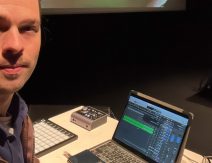
My first five days were spent trying to develop the idea into a piece that might actually be enjoyable to listen to for 40–45 minutes. I had almost an hour of ambient birdsong that sometimes sounded beautiful and other times quite scary, as waves and shards of stretched audio would overwhelm the frequency spectrum. I started looking at ways to process it further: using old spectral-analysis software to remove harmonic resonances, using autotune to control pitch drift, and then turning the audio into MIDI data — magic!


I typically started each day working on the tech element, which was slow and cumbersome, helped immensely by John (legendary Riverbank tech man). In the afternoons, I improvised along to what I had, letting the notes evoke my instrumental responses, recording, and then listening back later. By Friday I had crystalline bird audio and MIDI data playing two software synths that reinforced the main harmonic resonances from the birdsong. Some of the sounds moved unpredictably — a bit of a head melt — but gradually I built an intuition for what notes were dictating movement and when I could step away and follow my own ideas on the guitar. It became a balance between the track “playing me” and leaving space for me to play myself.

I returned two weeks later to add the audio clips and a visual element with collaborator Keelin Sutcliffe. Keelin was working with natural-world visual material, run through software so it looked deliberately affected but still recognisably organic. We talked about symbols that connected us, and what a bird sees, passes by, or perches on. The result was time-lapses of flowers opening, water, and even an edit of letters sent to Keelin’s father when he lived in Australia. It was an extended tech setup — figuring out how to make this look good and work in real time, while keeping space for the spontaneity of my musical parts.
I added archive voices of my great-aunt Peggy talking about growing up in Cork in the 1930s, along with recitations from John B. Keane, Edna O’Brien, and some shorter clips I found on YouTube. All were under a minute, but together they began weaving a sort of narrative. On the final performance day, I hurriedly cut space into the birdsong and synth tracks to make room for the voices and for my guitar playing.

Although it felt a bit pressured, knowing there would be a public showing of the work-in-progress helped. That performance pressure turned a good idea into a piece of some sort. I enjoyed the challenge, even if it felt a bit exposing not to be on the mic explaining or contextualising the piece until afterwards. And it went well — with some interesting feedback too.

The residency was a great exercise in exploring the question:
“What happens when I remove the audience’s (and my own) expectations?”
I’m not sure where the piece will go next, as it feels more like an installation or site-specific work than something for a concert setting. That’s part of what makes it exciting. I suspect the next iteration will feature my voice somehow, but I’m looking forward to seeing what emerges. I’m really grateful to have had the time and space to explore. Big thanks to Louis & Aoife at IMC, Matt & John at Riverbank, and Keelin & Fiyin for collaborating with me.
You Might Also Like