


Ronan Guilfoyle on Bemusement Arcade
- Interviews / Q&As
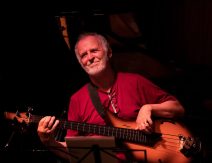
Ronan Guilfoyle’s new quartet Bemusement Arcade finds deep inspiration in the jazz tradition while challenging its rhythmic foundations with daring innovation.
Their most recent release - At Swing, Two Birds - is a clever nod to Irish literary giant Flann O’Brien’s At Swim-Two-Birds, while also referencing rhythmic and harmonic ideas drawn from Charlie Parker’s groundbreaking language. It’s a fitting symbol for the way this album playfully dances between old and new, between swing and surprise.
Ahead of their show at the Chelsea Drugstore on February 26th, Ronan told us about the group and their work.
LS: So tell me about Bemusement Arcade, please.
RG: The title is a play on “Amusement Arcade” and the idea of being bemused. It’s a group I put together to explore how to incorporate rhythmic elements not usually found in traditional jazz into that context.
A lot of our music is swing-based, but we also incorporate rhythms like boogaloo and other grooves. I think it’s important to understand that, in traditional jazz, swing is often treated as the primary or default groove — let’s call it that. Swing is part of a larger family of rhythms that came from West Africa via the slave trade. At its core is the 3-2 polyrhythm, the DNA of African diasporic music — jazz, salsa, reggae, calypso, funk, and more.
Over the past few decades, a lot of rhythmic experimentation in jazz has drifted away from that 3-2 DNA toward purely duple meters, and I felt something was lost. The feeling of jazz is rooted in that rhythm — from 1930s swing to Elvin Jones with Coltrane or Tony Williams with Miles Davis. With Bemusement Arcade, I wanted a band that could explore new rhythmic ideas while retaining the groove and feel of traditional jazz.
LS: Can you tell me about who’s in the band and how you chose them?
RG: These are specialists — musicians deeply grounded in jazz who also have the technical skill to handle complex rhythms. Often, those two worlds don’t meet: some players groove beautifully in traditional jazz but struggle with odd meters, while others are masters of metric modulation but don’t sound convincing in swing. I needed people fluent in both.
The music is challenging to play but not to listen to — it grooves. So I chose players who could meet the technical demands while keeping everything feeling good.
LS: Who are the band members?
RG: On drums is Darren Beckett, one of the most experienced drummers around. I’ve known him since he was a teenager — he attended a summer school at the University of Ulster where Keith Copeland was teaching. Keith immediately spotted his talent and helped him study in Cologne and later at the New School in New York.
Darren spent about 20 years in New York, playing with top musicians and studying with greats like Billy Hart. He’s completely steeped in American swing and groove. From a bassist’s perspective, playing with him is like getting into a Rolls Royce — the groove just drives itself.
On guitar is my son, Chris Guilfoyle. He studied in Newpark and then completed a master’s in Lucerne. He’s been surrounded by my rhythmic experiments his whole life. He knows this material inside out and writes his own music in similar areas. He’s technically superb and comfortable in both traditional and experimental contexts.
Finally, on alto saxophone is Sam Norris, the youngest member, about 25. I first met him while teaching at the Royal Academy of Music in London just before the pandemic. He stood out immediately — technically brilliant, deeply rooted in jazz tradition, and with a distinctive sound influenced by Paul Desmond and Lee Konitz, yet with a modern sensibility. When this project came together, I called him, and he’s been a fantastic fit.
LS: Can you tell me a little about the record itself?
RG: The album draws on classic jazz forms — blues, rhythm changes, and standards — while mixing in boogaloo-inspired grooves and other rhythmic twists. The title, At Swing Two Birds, plays on Flann O’Brien’s At Swim Two Birds and refers to Charlie Parker — “Bird” — combining elements from two of his tunes. It’s familiar yet unique — the essence of the band’s approach.
Some pieces are grounded in tradition but subtly altered with complex rhythms, unusual time signatures, or melodic twists. The goal is to challenge us as musicians while remaining accessible and swinging for listeners. The music blends the familiar and unfamiliar, offering something fresh without losing touch with the jazz tradition.
LS: How do you see the relationship between tradition and innovation in your music?
RG: Jazz has always been innovative. Unlike some other African diasporic styles, which preserve older traditions, jazz evolved through constant reinvention — from Buddy Bolden and Louis Armstrong to Charlie Parker, Miles Davis, and John Coltrane.
That said, debates over “real jazz” have always existed. Armstrong once dismissed bebop — just 20 years after his own innovations — as “Chinese music.” Later, in the 1980s, Wynton Marsalis argued that only blues and swing were truly jazz, while others claimed swing was outdated.
I’ve never seen tradition and innovation as opposing forces. They coexist beautifully. I grew up with traditional jazz at home, but I’ve always worked with new rhythmic ideas. Bemusement Arcade is my most complete expression of that balance — where tradition and innovation meet naturally and are both present.
Ronan Guilfoyle’s Bemusement Arcade play at the Chelsea Drugstore on Thursday, Feb 26th. Tickets are available from improvisedmusic.ie
You Might Also Like